
Creating a report
In this article:
- Introduction
- Where do I start?
- Creating a custom report
- Creating a reusable report from your export
- Using a pre-built report
- Using a pre-built report template and creating your own
- Managing your custom pre-built report templates
Introduction
One of the core functions in Little Green Light is the ability to quickly and easily search on the data stored in your account and then either view it online or export it into a report. You can approach reporting in multiple ways, and the best way to create a report may vary, depending on the information you are looking for. For these reasons, we recommend spending some time thinking about the kind of report you want before you get started. The article Need to build a report but don’t know where to start? can provide guidance on the different reporting options and formats available.
You can create a report in LGL in these three primary ways:
- Use one of the pre-built report templates provided in your account (located in the Reports menu)
- Define your own search criteria and use one of the pre-built report templates available within the report builder
- Create a custom report that you design yourself
Where do I start?
The answer to this question depends on the types of information, or record types, you want your results to be grouped by. The most common reports are typically created and exported from the Constituents and Fundraising tabs, but reports can also be run from the Contact reports, Tasks, Volunteering, Notes, and Documents pages within the Activities menu as well as Goals from within the Fundraising menu. The chart below will help determine where you should start your search.
| Constituents |
If your report is designed to answer the question “who?”, start with a constituent search. What you want to know about those constituents can then be defined within the report after you export the search results. (Read detailed instructions on generating a report from the Constituents tab.) Constituent searches and reports are best for searching and reporting on constituent record details and will return one row in your report for each constituent record returned by your search. Example: Who has given $500 or more last fiscal year? |
| Fundraising |
If your report is looking for detailed information about gifts and gift attributes, start with a fundraising search. (Read detailed instructions on generating a report from the Fundraising tab.) Fundraising searches are typically best when you’re looking for information on how many gifts were received or how much money was raised over a given time frame. Fundraising searches and reports return one row of data per gift record pulled in by your search. If a constituent has more than one gift that meets the search criteria, their name will appear in more than one row, since the results are based on the gift record. Example: Which gifts were received last month and what was their total? |
| Goals |
If your report needs to identify goal records and details about the goal, such as name, ask amount, constituent, owner, and tasks, start with a goal search. Search for goals by navigating to Fundraising > Goals. Example: Which goals from the Annual Campaign were received last fiscal year? |
| Contact reports |
If your report needs to contain specific contact reports and their details, start with a contact reports search. The focus of the search and export will be the contact report itself, not the constituents. If a constituent has more than one contact report that meets the search criteria, the constituent’s name will appear in multiple rows. Search for contact reports by navigating to Activity > Contact Reports. Example: Which contact reports were created for board members this year? |
| Tasks |
If you want to report on specific task records that have been created in LGL and their details, search in Activity > Tasks. Example: Which high-priority tasks are not complete? |
| Volunteering |
Volunteering searches return records of future volunteer commitments or detailed recorded volunteer time. If you want a summary of volunteer time for constituents over a certain time period, start your search from the Constituents page instead. To search for volunteering records, navigate to Activity > Volunteering. Example: How many gardening volunteer sessions were longer than two hours last week, and who were those volunteers? |
| Notes |
If your report needs to return specific details about your note records, start with a notes search. To search for notes, navigate to Activity > Notes. Example: Find the note type "quotation" from this year. |
| Documents | Documents searches can be used to identify and find documents that you have uploaded into your LGL account. Unlike the other search types, the results cannot be exported into a report. However, you can download the documents from your search results rather than export them into a report. To search for documents, navigate to Activity > Documents. |
Once you’ve decided where you want to start, you can then search for the criteria you need and generate your report.
For information on creating searches, read these Knowledge Base articles:
For step-by-step information on creating reports, read Building, customizing, and scheduling reports.
Creating a custom report
A custom report can be created from either the Reports tab or by starting a search in one of the main navigation tabs, for example, Constituents, Fundraising, or Activity.
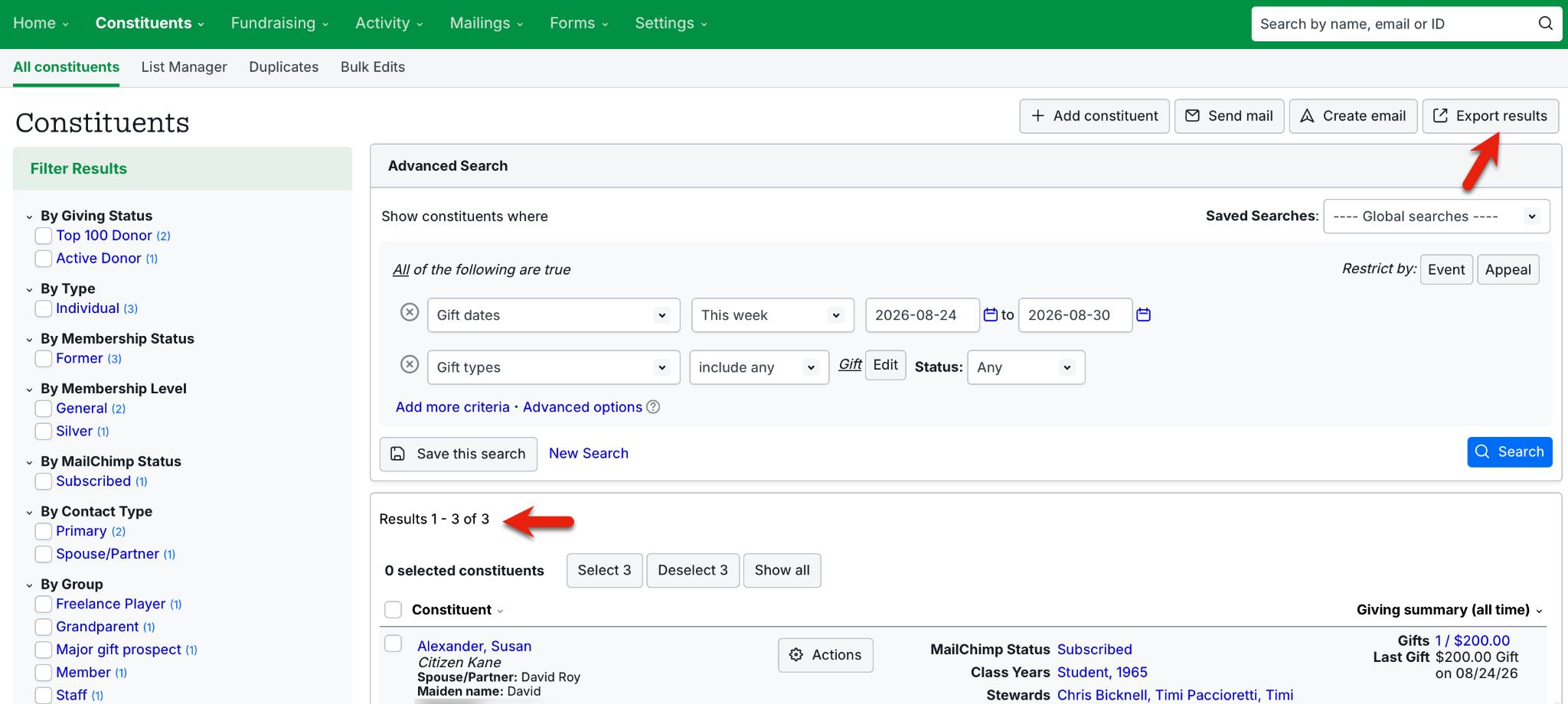
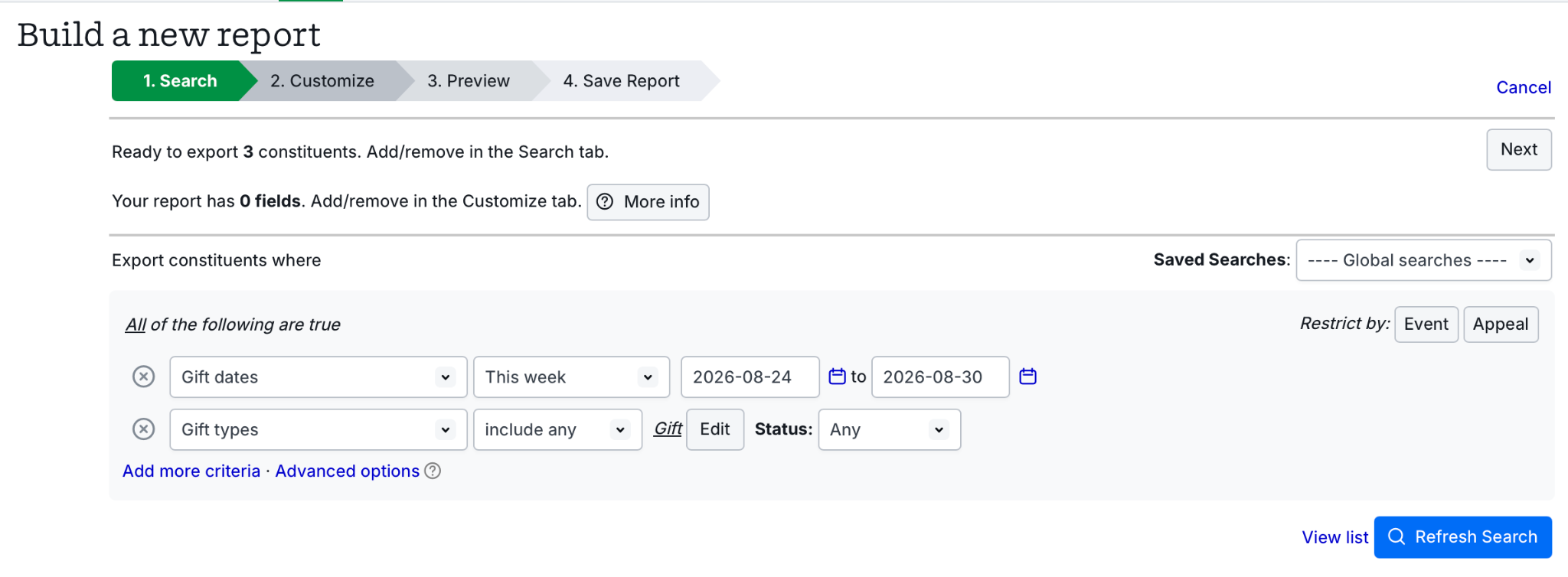
When creating a custom report, it’s a good idea to start in the Constituents, Fundraising, or Activity tab rather than directly from the Reports module. The reason for this is better visibility into your search query. In the Constituents, Fundraising, and Activity tabs, you can view the search results and verify the accuracy of the criteria, whereas in the Reports module you cannot easily preview your search data. You can then click the “Export results” button to generate a report from your search results.
Compare the two screenshots below.
Search query from the Constituents tab
Search query from the Report builder
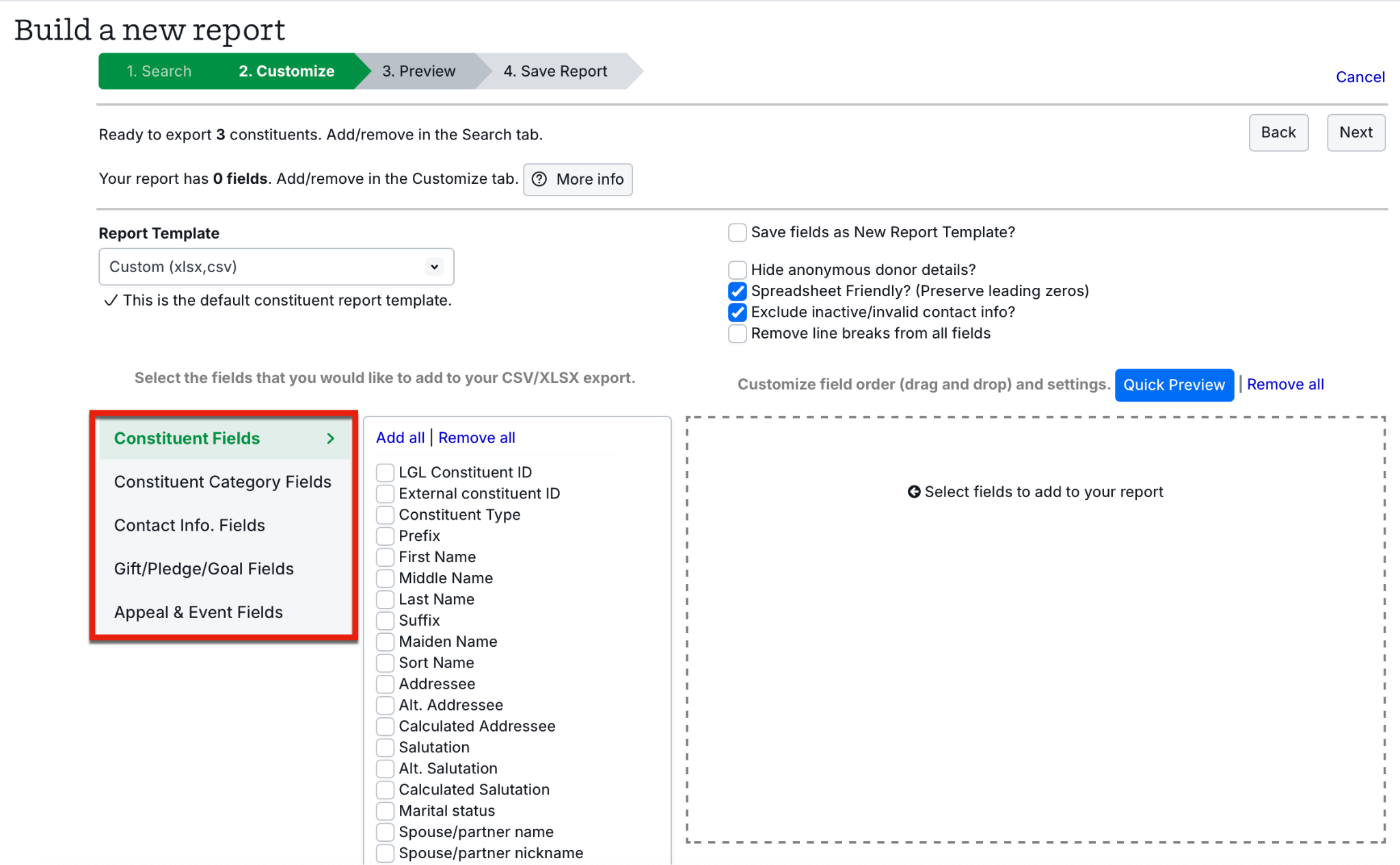
Once you have run the search, select the Customize tab to add or edit the fields you would like to see in your report. A menu of the available field types will be listed on the left. When you select the menu, the specific report fields will be available for selection.
When you have added all the fields you want to use, you can preview your selection and then proceed through the remaining steps to complete the process.
Creating a reusable report from your export
In the final step of the report builder, you'll see an option to create a re-usable report from your export:
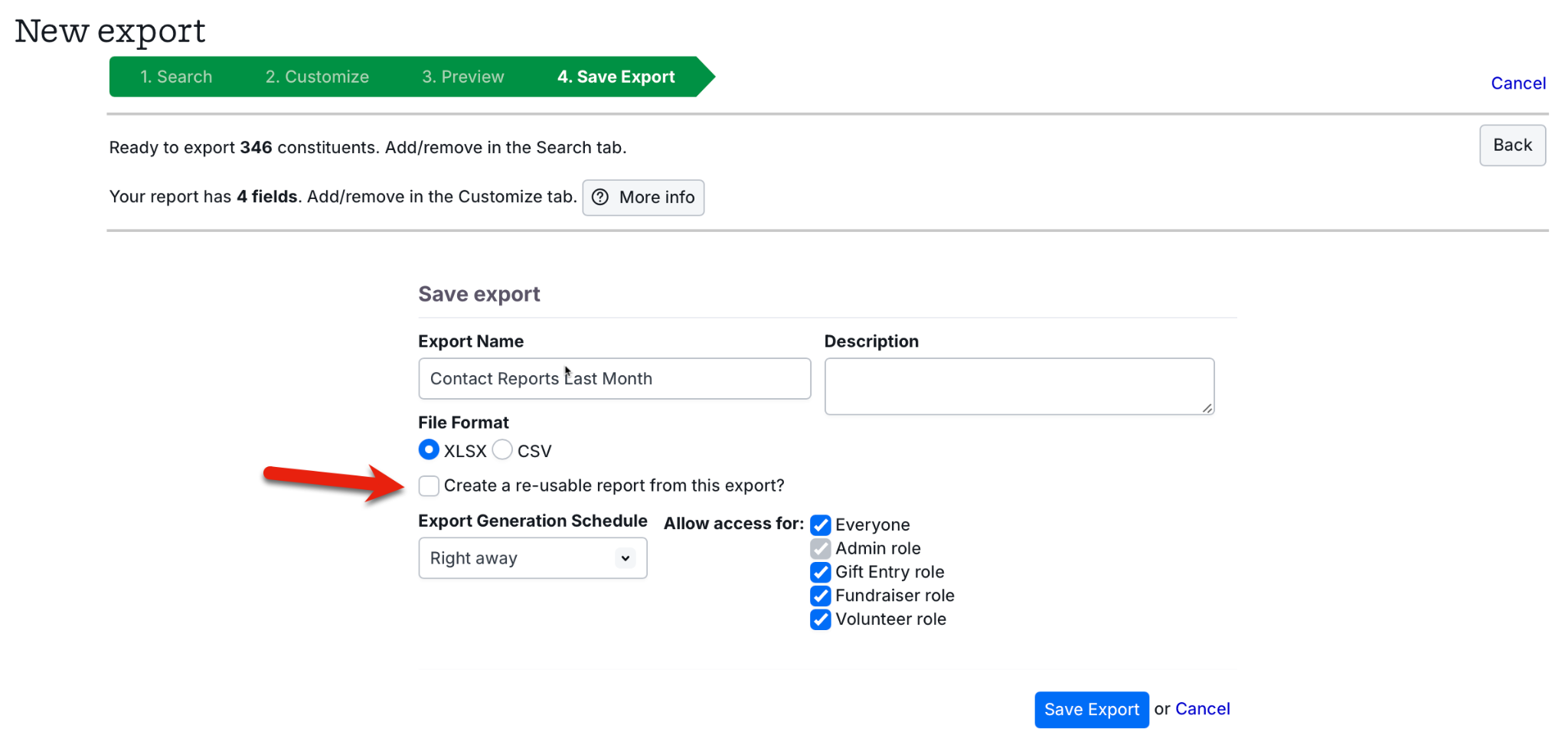
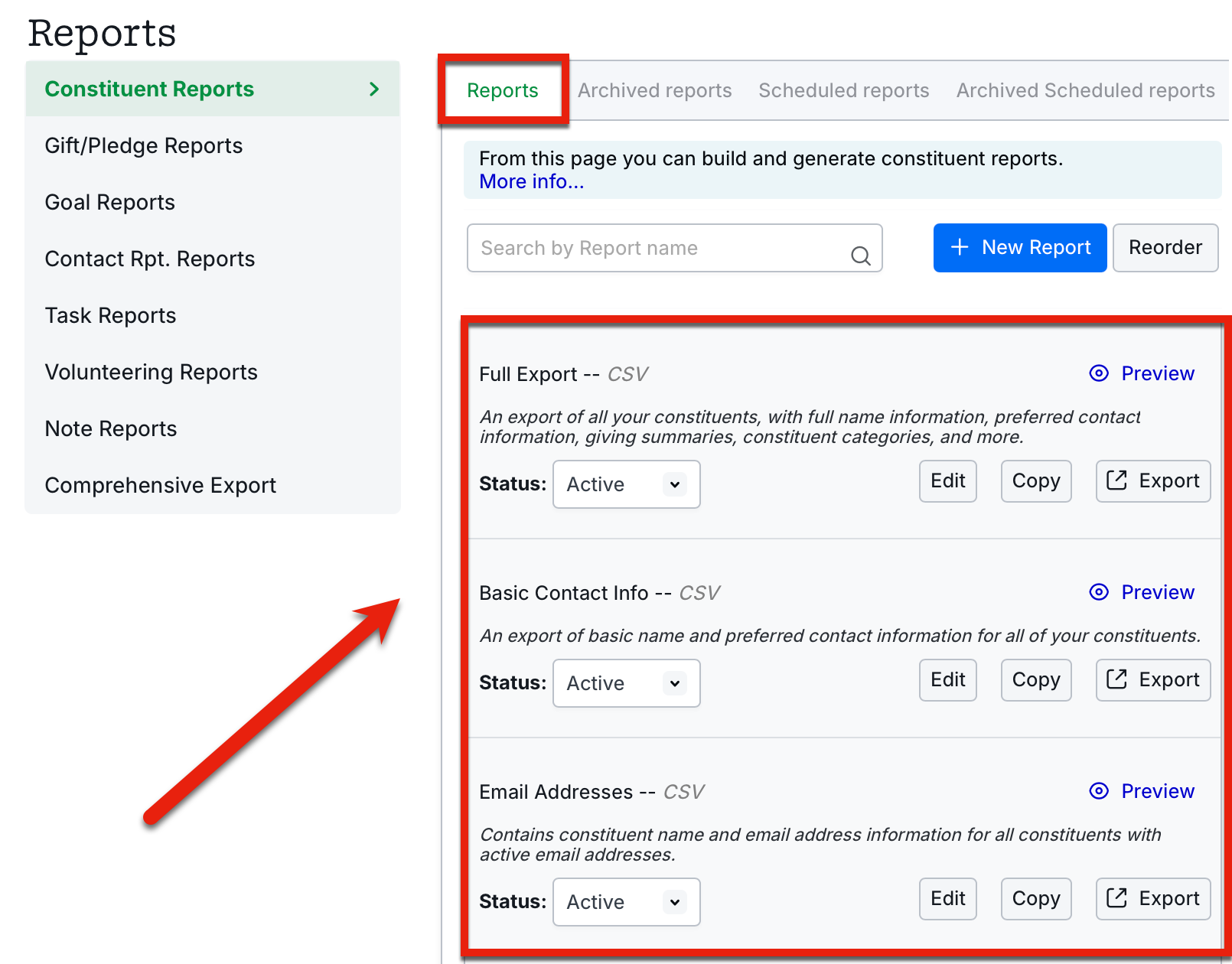
This option allows you to add an export you have created as a pre-built report in your Reports page. Any export that you select this option for will become accessible in the Reports section for each type of report (Constituent, Gift, etc.):
Using a pre-built report
Pre-built reports provided by default in your account include constituent reports, fundraising reports, volunteering reports, and more. The Reports tab, located in the Home menu in your account, is a good place to start if there’s a report available there that you want to use. It's a good idea to become familiar with pre-built reports by type before building your report from scratch as this can save you time.

Most report templates can be edited, copied, or exported:
- The Edit option lets you change the report itself. When you save it, you will overwrite the old report (both the search criteria and the output fields).
- The Copy option gives you a new copy to work with, which you can then save with a new file name.
- The Export option sends you straight to the Reports page, where you can save and download the report.
Using a pre-built report template and creating your own
After creating your search in the appropriate tab and exporting the results, you can select from a variety of pre-built XLSX/CSV and PDF report templates. XLSX/CSV templates can be customized, but PDF templates are not customizable.
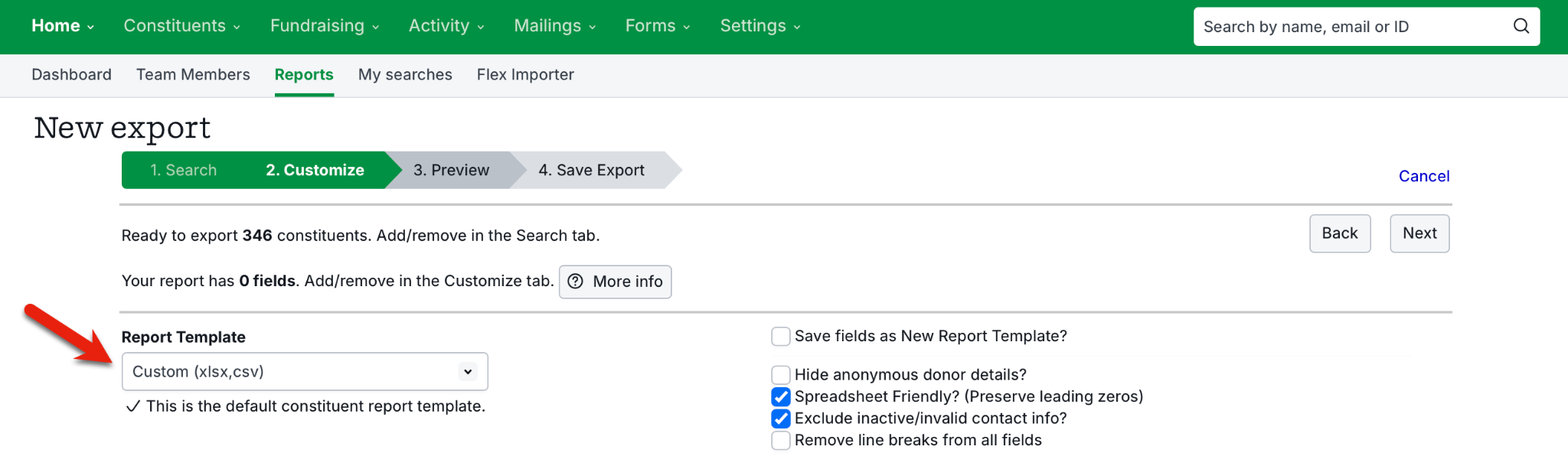
Choosing a pre-built report template to populate your export/report with pre-set columns requires selecting an option from the Report Template dropdown menu on the Customize tab in the report builder, as shown here:
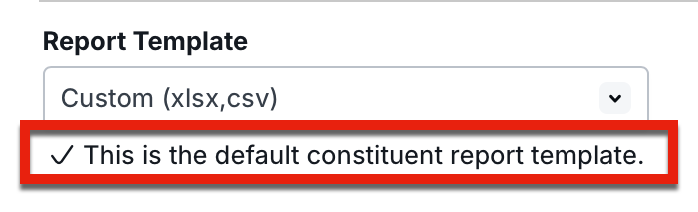
When you select one of the available report templates and check the “Save this template as your default selection for constituent reports” box, the report template you selected becomes the default report template and will remain selected for future reports that you build:
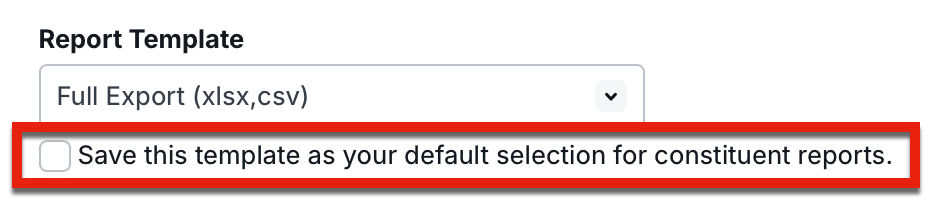
If you make a different report template selection, you'll have the option to select that new report template as the default:
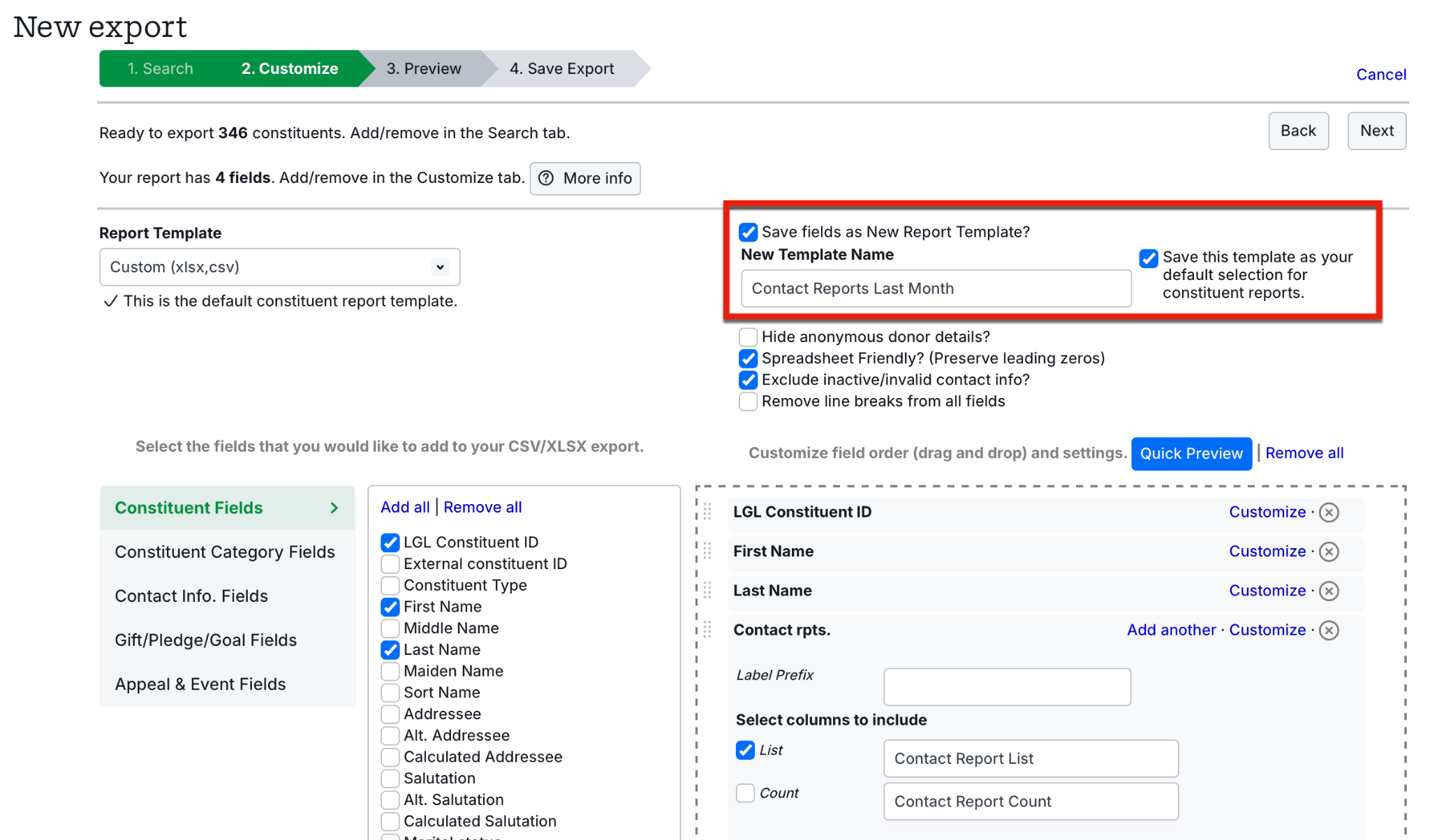
You can also select custom columns and, if you want to export this data into a report on a regular basis, create a new default report template option from your custom selection:
Managing your custom pre-built report templates
To edit or delete a custom pre-built report template, navigate to Home > Reports > Constituent Reports > Manage Templates. You can click the Edit button to make changes to the report template or the Delete button to remove it:
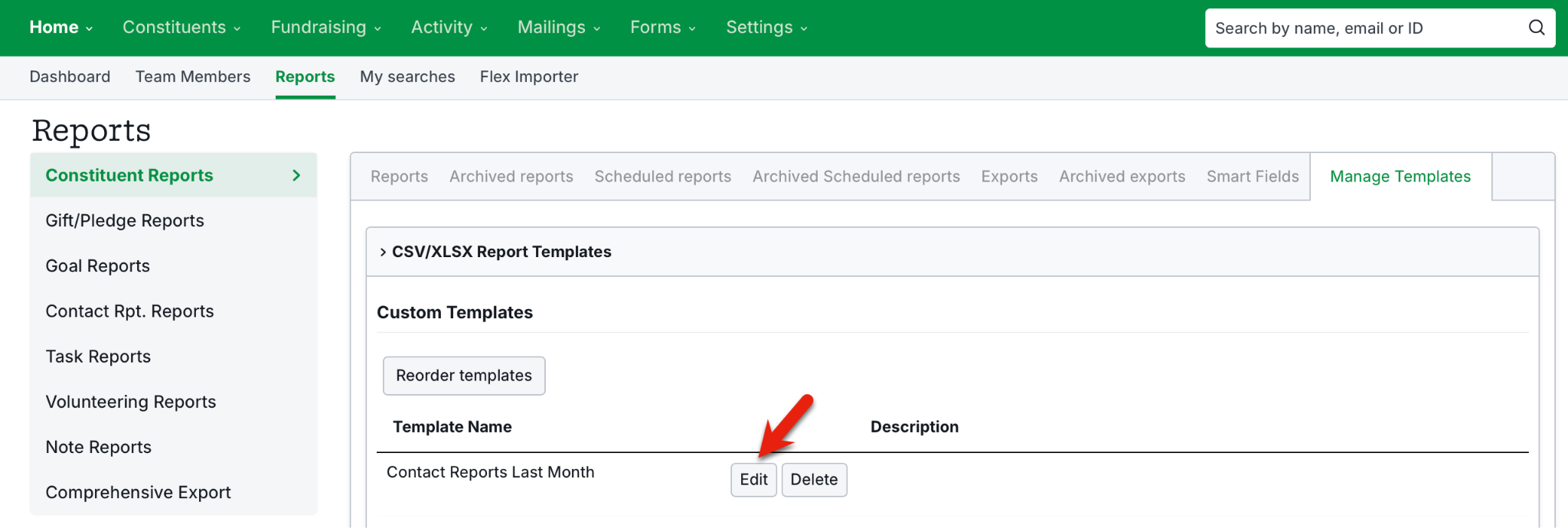
While the instructions above are specific to constituent report templates, they can apply to fundraising and all other report types as well. You can locate the other report template types by navigating to Home > Reports and then selecting the applicable report type. You can then click into the Manage Template tab from that report type menu.